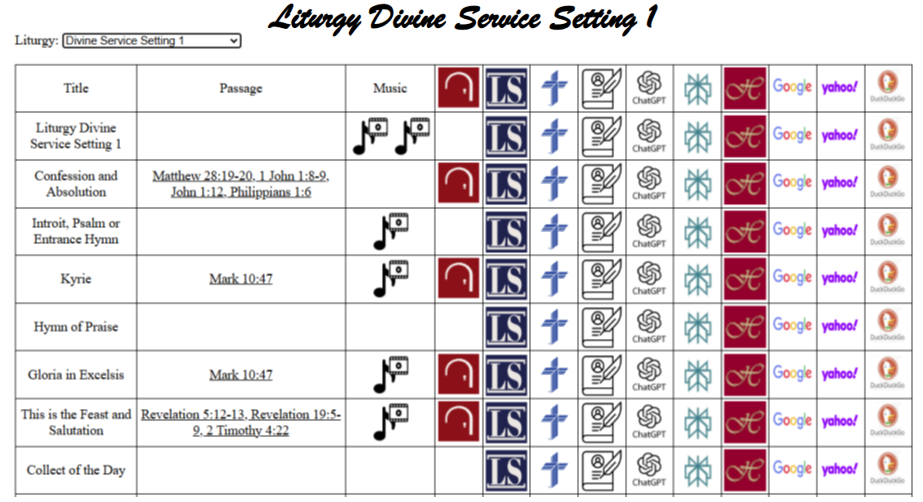
The Lutheran Hub Liturgy page is an interactive reference guide to Lutheran worship services, providing access to Divine Service Settings 1–5 as well as daily offices such as Matins and Vespers. It organizes each service by its individual components - for example, Confession and Absolution, Introit, hymns, Scripture readings, creed, sermon, prayers, Holy Communion, and benediction - and connects these elements with supporting biblical passages and related resources. For instance, the Confession and Absolution section of Divine Service Setting 1 links to texts such as Matthew 28:19–20, 1 John 1:8–9, John 1:12, and Philippians 1:6, helping users see the scriptural foundation of the liturgy. By combining the order of service with biblical cross-references, the page supports worship preparation, catechesis, personal study, and a deeper appreciation of the Word-and-Sacrament pattern of Lutheran public worship.
The Liturgy dropdown list contains the full set of LCMS liturgies. Selecting one of these liturgies will display the components of that liturgy in the table. Each piece of the liturgy can then be studied using the various linked images for the rows.
The descriptions below were generated with the assistance of the Perplexity chatbot.
 Bible Gateway is a longstanding online Bible-reading and study website, founded in 1993 and now operated by HarperCollins Christian Publishing, that makes Scripture freely accessible through more than 200 Bible translations in over 70 languages. Users can look up passages or search by keyword, phrase, verse, or topic; compare translations; listen to audio Bibles; follow reading plans; receive a daily Verse of the Day; and save highlights, notes, and bookmarks through a free account. Its optional Bible Gateway Plus subscription removes advertisements and adds a digital library of study Bibles, commentaries, dictionaries, and word-study tools connected to particular passages, making it useful for both devotional reading and more serious Bible study. Because its resources represent a wide range of evangelical traditions and translations, Lutheran users should use its study notes and commentaries critically, measuring all interpretations by Holy Scripture and the Lutheran Confessions rather than treating the site itself as a confessional Lutheran authority.
 LCMSSermons is an unofficial online repository of sermon manuscripts and preaching resources associated with pastors and congregations of the Lutheran Church - Missouri Synod. Its purpose is to provide examples of Christ-centered, Law-and-Gospel preaching on appointed lectionary texts and other biblical passages, giving pastors, seminarians, teachers, and lay readers material for sermon study and devotional reflection. Unlike the LCMS Document Library or LCMS Worship resources, which are official Synod platforms offering vetted worship-planning, lectionary, Bible-study, and congregational materials, LCMSSermons should be understood as a supplementary resource rather than an authoritative voice of the Synod. Individual sermons vary according to their authors, contexts, and theological emphases, so they are best used as aids for engaging the biblical text - not as material to reproduce uncritically. For LCMS use, every sermon should be evaluated in light of Holy Scripture, the Lutheran Confessions, the church year's propers, and the pastoral responsibility to preach repentance, forgiveness, Christ crucified, and the gifts of Word and Sacrament.
 Biographical/historical information for a hymn or individual.
 The Article image sets the default chatbot prefix for the Chatbot Q&A webpage to "write an article on". The Lutheran Hub "Chatbot Q&A" webpage is an online question-and-answer resource designed to help users explore biblical, theological, and practical Christian questions through a chatbot-style format, likely drawing on Lutheran and LCMS-oriented assumptions. From an LCMS perspective, such a tool may be useful as a starting point for study, reflection, or locating relevant biblical themes, particularly if it encourages users to read Scripture carefully and directs them toward Christ's saving work. Yet it should not be treated as an official LCMS source, a substitute for the pastor's office, or an authority alongside Holy Scripture and the Book of Concord; AI-generated answers can be incomplete or mistaken and must be tested against the Scriptures, which the LCMS confesses as the inspired Word of God and the sole rule and norm of doctrine. For questions involving doctrine, conscience, spiritual distress, or pastoral care, the proper next step is consultation with a faithful pastor and participation in the Church's preaching and sacramental life.
 LCMS.org is the official website of The Lutheran Church - Missouri Synod, serving as the Synod's principal online source for its confession, mission, ministries, news, governance, and resources. It explains that the LCMS receives the Holy Scriptures as the inspired Word of God and subscribes to the Lutheran Confessions as a correct exposition of Scripture, while proclaiming its mission "vigorously to make known the love of Christ by word and deed within our churches, communities and the world." The site provides doctrinal statements and frequently asked questions; information on congregations, districts, seminaries, leadership, and Synod-wide ministries; news and convention materials; worship, education, mercy, mission, family, and church-worker resources; and tools that assist pastors, congregations, schools, and individual Lutherans in their shared life and service. In short, LCMS.org functions as the Synod's official public gateway for confessing Christ, communicating its teachings and work, and equipping its members to make disciples for life.
 Hymnary.org is a comprehensive online database of hymns, hymn tunes, hymnals, and worship music designed for worship leaders, musicians, researchers, and anyone interested in Christian hymnody. Users can search or browse by hymn title, first line, tune, meter, key, Scripture reference, author, composer, or hymnal, and many entries include text, musical scores, audio or media links, publication information, and cross-references showing where a hymn appears. In partnership with The Hymn Society in the United States and Canada, the site also hosts the Dictionary of North American Hymnology, bringing together more than one million hymn first lines and making it an especially valuable resource for tracing the history, authorship, musical settings, and use of hymns across denominations and hymnals. Founded in 2007 and based at Calvin University in Grand Rapids, Michigan, Hymnary.org serves as a free, searchable reference library for the study and planning of congregational song.