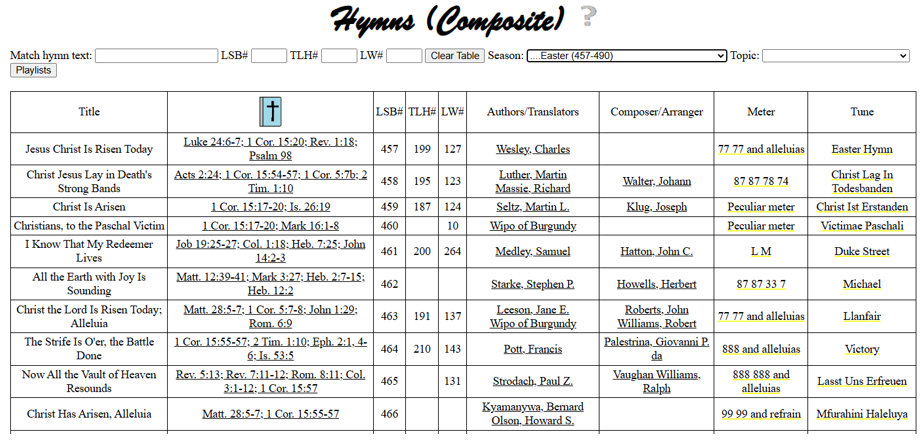
The Lutheran Hub Hymn Tunes page is a companion research tool for Lutheran hymns that helps users explore the musical characteristics and connections of individual hymns across Lutheran Service Book (LSB), The Lutheran Hymnal (TLH), and Lutheran Worship (LW). For a selected hymn, it presents information such as its title, hymnal numbers, authors or translators, composer or arranger, poetic meter, and tune name, then lets users select the hymn's meter to find other texts that can fit the same musical pattern or select its tune to identify other hymns sung to that melody. This makes the page useful for worship planning, hymn study, accompaniment preparation, and discovering alternative text-and-tune pairings while connecting congregational song to its biblical and theological context.
The text fields at the top are used to locate hymns within the various LCMS hymnals. The hymn text field can be used to identify hymns with the keyed in text in the title. The LSB, TLH and LW fields are used to select hymns by hymn number from the various hymnals. The season dropdown list can be used to select all (LSB) hymns for a specific season and the Topic field can be used to select all (LSB) hymns for a specific topic.
Multiple hymns can be identified in the LSB, TLH and LW fields by indicating a range using a dash (-) and separating hymns using semicolons. Therefore, the string "350-360;370;380" will locate hymns 350 through 360 and hymns 370 and 380.
Selecting the Playlist button brings up another webpage from which the songs on predefined playlists may be played.
For each hymn, a variety of information is displayed including the Bible passages for that hymn, the LSB, TLH and LW hymn numbers for the hymn, the authors/translators for the hymn, the composer and arranger for the hymn and the meter and tune for the hymn. Clicking the underlined text in the Bible column will display the Bible Outline webpage with the verses for the hymn added to the table at the top of that webpage. Clicking an author, translator, composer or arranger will display the Church Fathers webpage with that individual highlighted and added to the table at the top. Clicking the yellow-underlined meter will add that hymn and all other hymns with that same meter to the table at the bottom. Clicking the yellow-underlined tune will add that hymn and all other hymns with the same tune to the bottom table.
Entering a meter or tune into the text fields at the bottom will add the hymns with those meter or tune to the bottom table. and the additional information described in the next section. The music for the hymn is played by clicking the image in the Tune column and the hymn is sung by clicking the image in the Group column.
The table at the bottom behaves similarly to the table at the top with the exception that it contains columns (Music and Group) that can be used to listen to the music for the hymn or listen to the hymn being sung.
"txt=" - specifies that all hymns that match the passed-in text be added to the table
"lsb=" - LSB hymns to add to table. Formatting of hymn numbers same as manual entry (see above)
"tlh=" - TLH hymns to add to table. Formatting of hymn numbers same as manual entry (see above)
"lw=" - LW hymns to add to table. Formatting of hymn numbers same as manual entry (see above)
The descriptions below were generated with the assistance of the Perplexity chatbot.
 Hymn tunes (Tune column) and hymn texts (Group column) that are not copyrighted (i.e., are in the public domain) are shown using the musical note symbol
 Music tunes (Tune column) and music texts (Group column) that are copyrighted (i.e., not in the public domain) are shown using the copyright image.
 Hymnary.org is a comprehensive online database of hymns, hymn tunes, hymnals, and worship music designed for worship leaders, musicians, researchers, and anyone interested in Christian hymnody. Users can search or browse by hymn title, first line, tune, meter, key, Scripture reference, author, composer, or hymnal, and many entries include text, musical scores, audio or media links, publication information, and cross-references showing where a hymn appears. In partnership with The Hymn Society in the United States and Canada, the site also hosts the Dictionary of North American Hymnology, bringing together more than one million hymn first lines and making it an especially valuable resource for tracing the history, authorship, musical settings, and use of hymns across denominations and hymnals. Founded in 2007 and based at Calvin University in Grand Rapids, Michigan, Hymnary.org serves as a free, searchable reference library for the study and planning of congregational song.
 The Article image sets the default chatbot prefix for the Chatbot Q&A webpage to "write an article on". The Lutheran Hub "Chatbot Q&A" webpage is an online question-and-answer resource designed to help users explore biblical, theological, and practical Christian questions through a chatbot-style format, likely drawing on Lutheran and LCMS-oriented assumptions. From an LCMS perspective, such a tool may be useful as a starting point for study, reflection, or locating relevant biblical themes, particularly if it encourages users to read Scripture carefully and directs them toward Christ's saving work. Yet it should not be treated as an official LCMS source, a substitute for the pastor's office, or an authority alongside Holy Scripture and the Book of Concord; AI-generated answers can be incomplete or mistaken and must be tested against the Scriptures, which the LCMS confesses as the inspired Word of God and the sole rule and norm of doctrine. For questions involving doctrine, conscience, spiritual distress, or pastoral care, the proper next step is consultation with a faithful pastor and participation in the Church's preaching and sacramental life.