Description
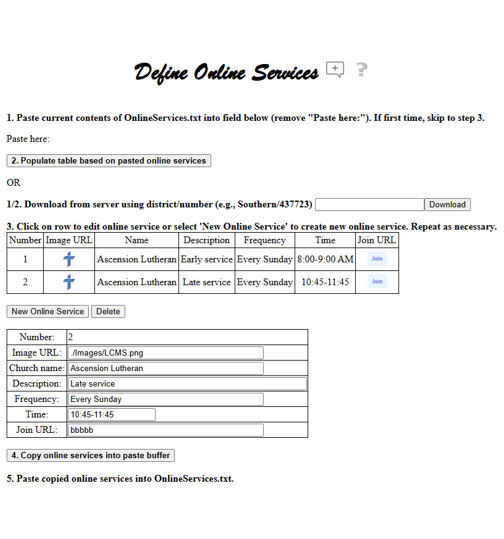
The "Define Online Services" webpage is used to define the online services for a specific church such that a user of that church's Hub homepage can access those online services. The online services defined via this website should be saved in a OnlineServices.txt file (process is described later) that should be included with the other church files sent when the specific church's definitions have been completed.
If this webpage is used to define the online services for the church, then the online services input field on the Define General Info webpage should be set to use the Hub link (as opposed to another link on that church's website for accessing the online services).
The user of the church's Hub webpages will see the online services, along with other online services from the LCMS, in a table showing the information from the "Define Online Services" webpage.

If online services are defined using this webpage and the online services input field on the Define General Info webpage is set to use the Hub link, then the online services image will be added to the Extended column on the Church Information webpage allowing direct access from that webpage to the online services.
Procedure
The process for creating, populating and persisting the online service information involves the following steps:
The first time this webpage is accessed, since there is no previously saved OnlineServices.txt file and since the default seeded files for the church do not include OnlineServices.txt, steps 1 and 2 can be skipped and the process should begin with step 3 (defining a new online service)
If the online services have previously been saved to a local OnlineServices.txt file, then the contents of that file should be copied and pasted into the "Paste here:" field overwriting the "Paste here:" text (step 1) and then clicking the "Populate table based on pasted online services" (step 2)
If the online services have previously been loaded to the server, then, as an alternative to the previous bullet, the contents of the OnlineServices.txt file on the server can be accessed by specifying the district/church number (e.g., Southern/437723) and then selecting the Download button
As step 3, new entries can be added to the table by clicking the "New Online Service" button and filling in the input fields for that online service. This process should be repeated for each online service to be added
When all the online service entries have been added, the online service information should be copied to the clipboard using the "Copy online services into paste buffer" button
The clipboard contents should be pasted into a local OnlineServices.txt file that will ultimately be included with the set of delivered files
Creating and Editing Entries
The "New Online Service" button creates a new online service and populates it with default values. These values can then be modified as desired using the input fields at the bottom.
Clicking a cell in a row of the table will populate the input fields at the bottom, allowing that entry to be edited as desired.
Input Fields:
Number: System assigned number for the online service.
Image URL: URL for the image that appears in the first column of the table displayed to the end user. If a logo file is specified in generalInfo.txt, then this file should also be the image file. If a file is specified that is not already available on the Internet, this file should be included with those sent for the church and should be identified with "./district/church number/filename" (e.g., ./Southern/437723/Ascension2.png).
Name: Name of the church hosting the online service.
Description: Description of the service (e.g., Early service - Divine worship).
Frequency: Frequency for the online service (e.g., Every Sunday).
Time: Time (starting and ending) for the online service.
Join URL: URL for connecting to the online service.
Saving online services to OnlineServices.txt
The "Copy online services into paste buffer" command button should be used to copy the online services defined on this webpage into the paste buffer (clipboard). Once copied, the online services should be pasted into a local OnlineServices.txt file that should then be included with the files sent when the church definition is complete.
Closing comments
The worship services are normally part of the calendar for the church and the hyperlink to connect to the online service is typically available via that calendar. However, the user may choose to also include it explicitly (and redundantly) via the process defined in this document.