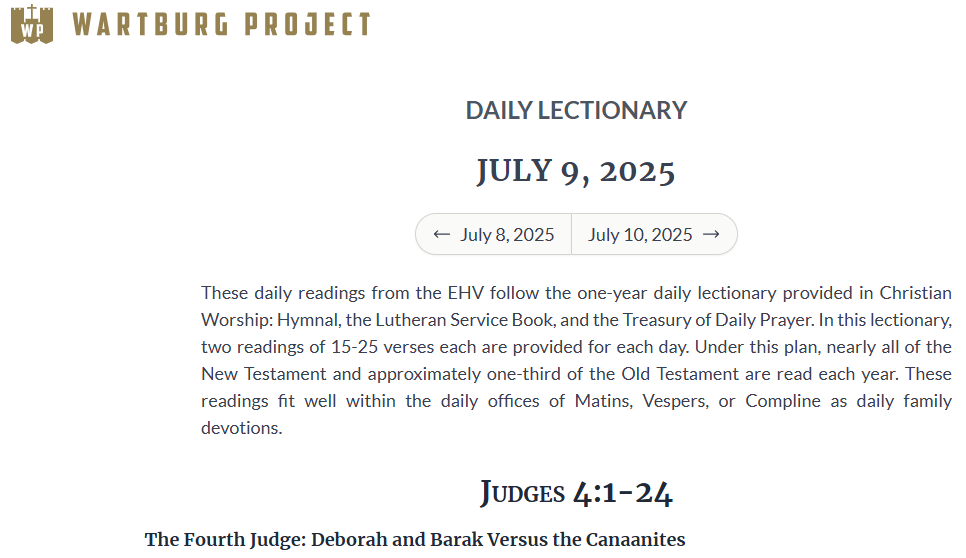
The Lutheran Hub Daily Lectionary page is a daily Scripture-study resource built around the Lutheran Service Book Daily Lectionary, helping users follow the church's regular rhythm of Bible reading throughout the year. It provides the appointed Old Testament and New Testament passages for each day and connects them with resources for reading or listening to the text, studying related material, preparing sermons or Bible studies, and exploring Lutheran teaching. The daily plan is designed not to cover every biblical chapter annually, but to assign two manageable readings of roughly 15–35 verses each day; over a year, this approach covers nearly all of the New Testament and about one-third of the Old Testament. By presenting Scripture according to the church calendar, the page supports consistent personal devotions, family reading, pastoral preparation, and participation in the wider worship life of the church.
The Daily Lectionary appears with the readings for the current month appearing. Each reading consists of one Old Testament and one New Testament reading. Clicking the yellow underlined text for a Bible reading will add that reading to the table at the top, from whence a more detailed study of the Bible passage can be performed.
The webpage supports a variety of ways of viewing the daily lectionary. By simply clicking one of the buttons above the table, it can be presented in any of the ways identified by the buttons.
The descriptions below were generated with the assistance of the Perplexity chatbot.
 Bible Gateway is a longstanding online Bible-reading and study website, founded in 1993 and now operated by HarperCollins Christian Publishing, that makes Scripture freely accessible through more than 200 Bible translations in over 70 languages. Users can look up passages or search by keyword, phrase, verse, or topic; compare translations; listen to audio Bibles; follow reading plans; receive a daily Verse of the Day; and save highlights, notes, and bookmarks through a free account. Its optional Bible Gateway Plus subscription removes advertisements and adds a digital library of study Bibles, commentaries, dictionaries, and word-study tools connected to particular passages, making it useful for both devotional reading and more serious Bible study. Because its resources represent a wide range of evangelical traditions and translations, Lutheran users should use its study notes and commentaries critically, measuring all interpretations by Holy Scripture and the Lutheran Confessions rather than treating the site itself as a confessional Lutheran authority.
 The Maps.html webpage at LutheranHub is intended to provide Bible maps with interactive "hotspots" that help readers locate and visualize the geographical settings of biblical events. By connecting places on maps with related information, the page supports the study of Scripture by showing where patriarchs, Israel, Christ, the apostles, and other biblical figures lived, traveled, ministered, or encountered major events. Its purpose is therefore educational and devotional: it helps users read the Bible with greater historical and geographical awareness, making the movement of the biblical narrative easier to follow. LutheranHub's site index specifically identifies this resource as "Bible Maps with Hotspots."
 BibleStudyTools.com is a free online Bible-study website operated by Salem Web Network, offering more than 100 Bible translations - including the ESV, KJV, NIV, NLT, CSB, and The Message - alongside tools for reading, searching, comparing, and studying Scripture. Its principal strength is its large reference library: users can consult classic commentaries by figures such as Martin Luther, Matthew Henry, John Gill, and John Wesley; use Strong's and Nave's concordances, Hebrew and Greek lexicons, Bible dictionaries, cross-references, encyclopedias, and historical texts such as Josephus and Foxe's Book of Martyrs. The site and companion iOS app also provide side-by-side translation comparison, reading plans, devotionals, notes, and personalized study features; a paid PLUS subscription adds ad-free use and additional premium study resources. Because the materials represent many theological traditions - including evangelical, Reformed, Wesleyan, dispensational, and Lutheran voices - an LCMS Lutheran should value it as a convenient research library while testing every commentary and doctrinal claim against Scripture and the Book of Concord rather than presuming the platform's resources speak with one confessional voice.
 The Article image sets the default chatbot prefix for the Chatbot Q&A webpage to "write an article on". The Lutheran Hub "Chatbot Q&A" webpage is an online question-and-answer resource designed to help users explore biblical, theological, and practical Christian questions through a chatbot-style format, likely drawing on Lutheran and LCMS-oriented assumptions. From an LCMS perspective, such a tool may be useful as a starting point for study, reflection, or locating relevant biblical themes, particularly if it encourages users to read Scripture carefully and directs them toward Christ's saving work. Yet it should not be treated as an official LCMS source, a substitute for the pastor's office, or an authority alongside Holy Scripture and the Book of Concord; AI-generated answers can be incomplete or mistaken and must be tested against the Scriptures, which the LCMS confesses as the inspired Word of God and the sole rule and norm of doctrine. For questions involving doctrine, conscience, spiritual distress, or pastoral care, the proper next step is consultation with a faithful pastor and participation in the Church's preaching and sacramental life.
 The Sermons.html webpage on LutheranHub functions as a Scripture-based sermon index and search tool. A user can enter or select a biblical passage and retrieve a list of related sermons or sermon resources, with columns identifying the passage, a date or reference number, and the source; the page also includes links to KFUO's Daily Chapel material as well as a variety of other sources. Its purpose, therefore, is to help pastors, teachers, and other readers locate preaching resources connected to particular texts of Scripture for study, devotion, sermon preparation, or hearing how a passage has been proclaimed in a Lutheran setting.
 The Sermon Q&A image sets the default chatbot prefix for the Chatbot Q&A webpage to "identify 5 points to include for sermon on". The Lutheran Hub "Chatbot Q&A" webpage is an online question-and-answer resource designed to help users explore biblical, theological, and practical Christian questions through a chatbot-style format, likely drawing on Lutheran and LCMS-oriented assumptions. From an LCMS perspective, such a tool may be useful as a starting point for study, reflection, or locating relevant biblical themes, particularly if it encourages users to read Scripture carefully and directs them toward Christ's saving work. Yet it should not be treated as an official LCMS source, a substitute for the pastor's office, or an authority alongside Holy Scripture and the Book of Concord; AI-generated answers can be incomplete or mistaken and must be tested against the Scriptures, which the LCMS confesses as the inspired Word of God and the sole rule and norm of doctrine. For questions involving doctrine, conscience, spiritual distress, or pastoral care, the proper next step is consultation with a faithful pastor and participation in the Church's preaching and sacramental life.
 LCMSSermons is an unofficial online repository of sermon manuscripts and preaching resources associated with pastors and congregations of the Lutheran Church - Missouri Synod. Its purpose is to provide examples of Christ-centered, Law-and-Gospel preaching on appointed lectionary texts and other biblical passages, giving pastors, seminarians, teachers, and lay readers material for sermon study and devotional reflection. Unlike the LCMS Document Library or LCMS Worship resources, which are official Synod platforms offering vetted worship-planning, lectionary, Bible-study, and congregational materials, LCMSSermons should be understood as a supplementary resource rather than an authoritative voice of the Synod. Individual sermons vary according to their authors, contexts, and theological emphases, so they are best used as aids for engaging the biblical text - not as material to reproduce uncritically. For LCMS use, every sermon should be evaluated in light of Holy Scripture, the Lutheran Confessions, the church year's propers, and the pastoral responsibility to preach repentance, forgiveness, Christ crucified, and the gifts of Word and Sacrament.
 The Lutheran Hub "Bible Studies" webpage is a searchable online index that helps users locate Bible-study and devotional audio resources by entering a biblical passage and viewing matching entries organized by passage, date or episode number, and source. Its search results prominently include KFUO Radio's Daily Chapel broadcasts and associated Scripture readings, enabling pastors, teachers, and laypeople to find Christ-centered Lutheran preaching, prayers, and reflections connected to particular texts of Scripture. From an LCMS perspective, such a tool can be useful for personal devotion, Bible-class preparation, and continued meditation on God's Word, especially when its linked materials faithfully distinguish Law and Gospel and remain consistent with the Scriptures and the Lutheran Confessions. Because LutheranHub.com is not an official LCMS website or agency, its individual links and resources should be evaluated carefully rather than treated as official Synodical teaching; Scripture itself remains the Church’s sole norm and authority for doctrine.
 The Bible Studies Q&A image sets the default chatbot prefix for the Chatbot Q&A webpage to "create Bible study for". The Lutheran Hub "Chatbot Q&A" webpage is an online question-and-answer resource designed to help users explore biblical, theological, and practical Christian questions through a chatbot-style format, likely drawing on Lutheran and LCMS-oriented assumptions. From an LCMS perspective, such a tool may be useful as a starting point for study, reflection, or locating relevant biblical themes, particularly if it encourages users to read Scripture carefully and directs them toward Christ's saving work. Yet it should not be treated as an official LCMS source, a substitute for the pastor's office, or an authority alongside Holy Scripture and the Book of Concord; AI-generated answers can be incomplete or mistaken and must be tested against the Scriptures, which the LCMS confesses as the inspired Word of God and the sole rule and norm of doctrine. For questions involving doctrine, conscience, spiritual distress, or pastoral care, the proper next step is consultation with a faithful pastor and participation in the Church's preaching and sacramental life.
 The DevotionsAll.html webpage at LutheranHub serves as a Scripture-indexed directory for Lutheran devotional resources. Users can enter a Bible passage and receive a list of devotions associated with that text, organized by the passage, date or identifying number, and source; the page also directs readers to KFUO Daily Chapel episodes. Its purpose is to help individuals, families, teachers, and church workers find devotion material for a particular portion of God's Word, supporting personal prayer, daily meditation, Bible study, and preparation for teaching or pastoral care.
 The Devotions Q&A image sets the default chatbot prefix for the Chatbot Q&A webpage to "create devotional for". The Lutheran Hub "Chatbot Q&A" webpage is an online question-and-answer resource designed to help users explore biblical, theological, and practical Christian questions through a chatbot-style format, likely drawing on Lutheran and LCMS-oriented assumptions. From an LCMS perspective, such a tool may be useful as a starting point for study, reflection, or locating relevant biblical themes, particularly if it encourages users to read Scripture carefully and directs them toward Christ's saving work. Yet it should not be treated as an official LCMS source, a substitute for the pastor's office, or an authority alongside Holy Scripture and the Book of Concord; AI-generated answers can be incomplete or mistaken and must be tested against the Scriptures, which the LCMS confesses as the inspired Word of God and the sole rule and norm of doctrine. For questions involving doctrine, conscience, spiritual distress, or pastoral care, the proper next step is consultation with a faithful pastor and participation in the Church's preaching and sacramental life.